
To break a cycle – In the End, It Was All Okay.
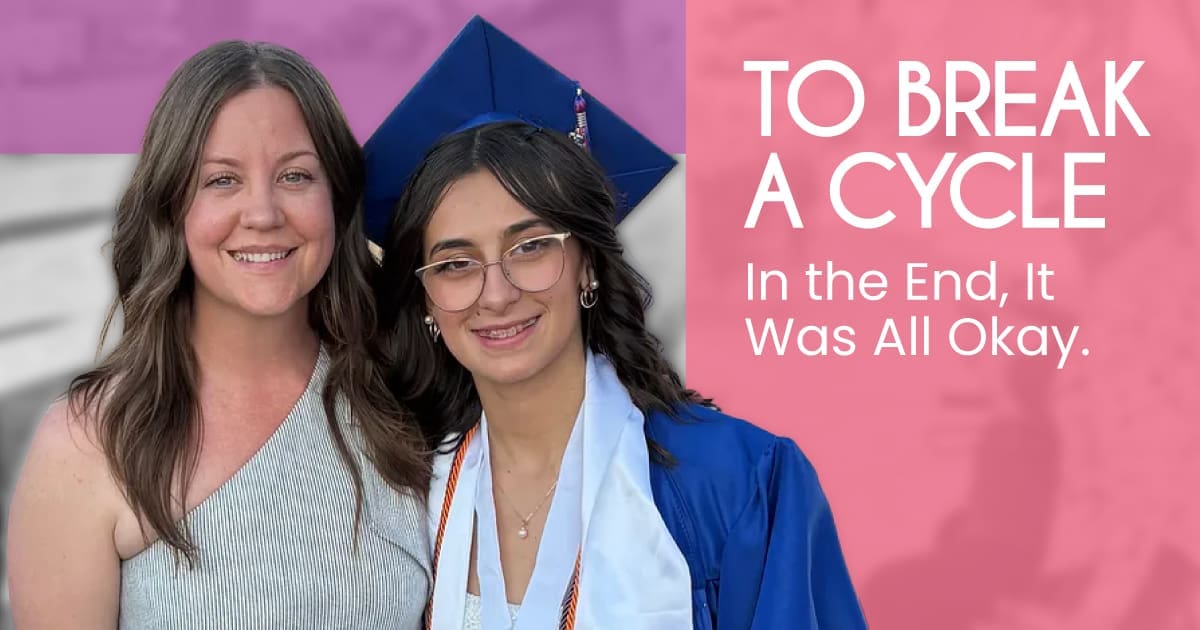
The Tuesday before last, my eldest daughter graduated from high school. It was everything you’d expect—joyful, bittersweet, emotional—but it was also something more.
She was chosen to give a speech at the ceremony. She titled it “In the End, It Was All Okay.”
As she stood on stage and began reading, something stirred inside me that I can’t quite explain. A full-body sob—silent but overwhelming—mixed with the weight of bricks lifting off my shoulders and a deep ache in my stomach.
In that moment, one thought rang clear:
We did it. She did it. I did it.
My family did it.
We broke the cycle.
I was raised in New Mexico by an extraordinary mom—young, beautiful, fun, smart, fiercely loving… and without the tools to heal herself. Like many women in our family, she worked tirelessly to provide for us, but no matter how hard she worked, we often went without.
My father struggled with substance use disorders and caused a great deal of pain for my siblings and me. His absence—and at times, even more so, his presence—left wounds that took years to name and even longer to begin healing.
By 18, I had already felt so much pain, held far too much responsibility and had worked nearly full-time for years. With no roadmap, I followed the only example I knew: I married young, became a mother soon after and settled in to building a family with little intention and no understanding of healthy love. What followed was a deeply painful, dysfunctional marriage that lasted 12 years.
When I finally made the decision to leave, it was terrifying. I had no financial independence, no formal education, no credit, and no support system in Arizona. But I looked at my three young children and I knew I couldn’t let the cycle continue.
 I wanted to show them what living could look like.
I believed education could be the bridge to the life I imagined. So, I walked that bridge—alone, slowly, and with relentless determination.
I enrolled in community college.
I left my marriage.
I juggled multiple jobs, raised three kids, earned my degrees from ASU, and built a successful career in social work from the ground up years behind my peers.
I’m proud to say I was the first woman in my family to graduate from college—and the first person, male or female, to earn more than an associate’s degree. That moment—graduating college—was one of the proudest of my life.
But what happened two weeks ago? That topped it.
My daughter graduated with honors. She was an athlete, a leader, the homecoming queen. A sweet, grounded, responsible young woman who fully lived her high school years.
She joined every club she wanted, tried every sport she was curious about. She traveled. She fell in love. She got her heart broken. She stayed up too late, studied too little, studied too much, failed a few tests, got good grades, made lifelong friends, and picked up a part-time job for fun—not survival.
She had the freedom to explore who she is.
She had choices.
She now has a preliminary plan—her plan—designed around her emotional, mental, physical, and financial needs.
She finished high school still full of joy. Still funny. Still kind. Still herself. Still soft.
That might be the most revolutionary part.
Because in my family, reaching graduation day usually meant carrying a body and mind full of trauma, burdens, and no clear path forward.
Yesterday, over dinner, she told me she’s decided to start therapy.
She said:
“I think I have a hard time making decisions sometimes, and I want to work on it. I think it’s a mix of people-pleasing and not trusting myself. I want to figure it out now.”
And that—right there—may be the biggest cycle we’ve broken.
She knows herself.
She has language for what’s happening internally.
She’s seen—by example—that when we hit a block, we face it. We don’t run from it. We don’t bleed it onto others. We do the work.
I’ve had to apologize many times in these 18 years. We’ve experienced every first together. I got a lot wrong. And some things, I got really right.
But I’ve always been honest.
When I messed up, I said I was sorry.
When I didn’t know what to do, I learned.
When I couldn’t afford therapy, I read library books, watched YouTube, intentionally tuned into my kids, and faced every wound that got activated.
I didn’t hide from what I once saw as a life built on poor choices.
I used it to teach. I wanted my kids to understand—not just absorb the stress.
They deserved to know the why behind our struggles, so they could build something different. And when I didn’t have the answers, I went out and found them—through hard, sometimes humbling conversations. Because I knew that healing a cycle meant naming it first.
I didn’t want my kids to inherit my silence around dysfunction—I wanted them to inherit the understanding of how to undo it.
Every time I turned toward the hard thing instead of the familiar thing, I healed.
And because I healed, I didn’t pass that pain down to them.
I don’t know what the next four years will hold for my daughter. But I do know this:
We are a different family now. I’m still unraveling choices made long ago, still navigating the logistical aches of a life I never meant to build the way that I did for so long. But her? She is beginning fresh—a blank slate, with a world of possibility at her feet.
She feels safe. She feels seen. She feels free. She feels capable.
And that’s all I ever wanted.
22 years ago, I was accepted into Arizona State University. I didn’t go.
No one in my life knew how to help me get there. I didn’t have the tools or the support. I was a scared, pain-filled young girl looking anywhere for relief.
In two short months, I’ll watch my daughter start her first semester at ASU.
And that full-circle moment?
It’s more than special.
It’s sacred.
This is what generational change looks like.
It’s not perfect.
It’s not easy.
But it is possible.
And now, I spend my days helping other women build bridges to that same kind of freedom.
Because once you’ve broken a cycle, you never forget what it took to get there—
and you never stop reaching back to pull someone else through.